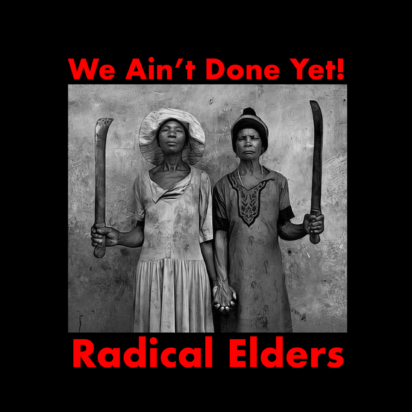
1926 – 2026
She gathered the broken. She gathered the discarded, the forgotten, the deliberately degraded—the mammy figurines, the Aunt Jemima syrup bottles, the racist postcards that white America had mass-produced for decades as though hatred could be made decorative—and she turned them into weapons.
Betye Saar, the Los Angeles-born assemblage artist whose shadow stretched across seven decades of American art, died on July 29 at the age of 100, leaving behind a body of work that permanently altered how the world understood Black womanhood, spiritual power, and the revolutionary capacity of found objects.
She was not simply an artist. She was an archivist of Black rage, a priestess of reclamation, a woman who understood that the most devastating political act she could commit was to pick up the image her oppressors had created to diminish her—and aim it straight back.
The Los Angeles Roots of a Radical Vision
Betye Irene Brown was born on July 30, 1926, in Los Angeles, California, into a family whose life straddled the color lines of a city still inventing its own mythology. She spent formative years in Watts, the historically Black neighborhood that would later erupt in the uprising of 1965—an uprising whose fury would echo through Saar’s art for the rest of her life.
As a child, she visited the Watts Towers with her family, watching Simon Rodia press broken bottles and ceramic fragments and steel rods into spiraling monuments that nobody had commissioned, and nobody could ignore. That image—of a lone craftsman transforming refuse into transcendence—lodged itself in Saar and never left.
She earned her bachelor’s degree in design from UCLA in 1949, studying printmaking and eventually moving through several Los Angeles institutions and the University of Chicago. Her early work produced prints, drawings, and illustrations rooted in the occult and the mystical—zodiac imagery, tarot iconography, the visual grammar of divination. These were years of formal discipline and spiritual curiosity, a period in which Saar built the interior vocabulary she would later detonate into political fire.
The turn came gradually and then all at once. In the late 1960s, as the Civil Rights Movement crested into the Black Power era, as cities burned and Black artists began to ask loud, urgent questions about what their practice owed their community, Saar discovered the assemblage form.
She had long collected objects—buttons, beads, old photographs, watch parts, feathers, bones—but now she found the box, the shadow box, the assemblage frame, and understood that these vessels could hold contradictions the way no flat canvas could.
They could hold history.
They could hold grief.
They could hold fury dressed as beauty.
The Liberation of Aunt Jemima and the Birth of a New Art Language
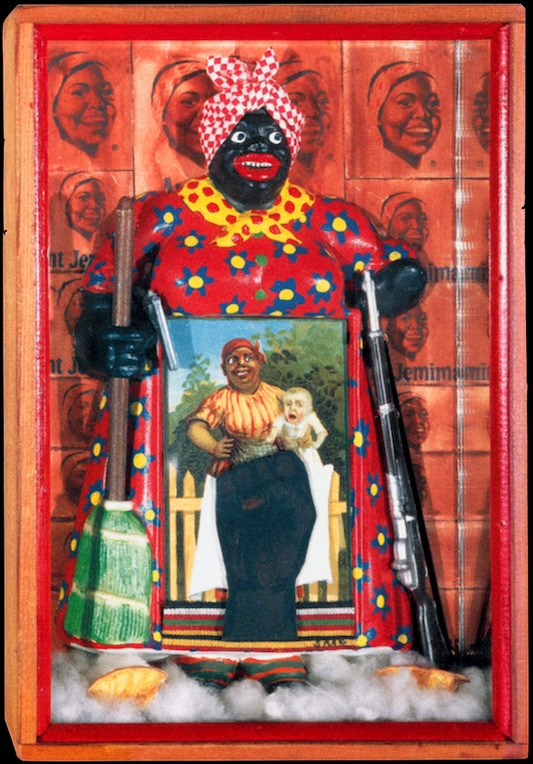
In 1972, Saar completed the work that would define her reputation and ignite a firestorm of conversation that has never fully died down. The Liberation of Aunt Jemima placed the most recognizable mammy figure in American commercial culture—the broad-faced, kerchief-wearing Aunt Jemima from pancake syrup bottles and kitchen calendars—inside a shadow box and armed her. A rifle in one hand, a broom in the other, and a raised fist embedded in the center. Behind her, rows of Aunt Jemima memo pads repeated the image into infinity, as though the mass reproduction of that figure had itself become the thing that demanded destruction.
The piece arrived at a specific moment. The Black Arts Movement was reshaping what Black cultural production could look like, sound like, and demand. Poets like Amiri Baraka and Sonia Sanchez were writing work that cut like glass. Muralists were painting the sides of buildings in Chicago and Detroit and Oakland with images of Black liberation. Saar entered that conversation not with a manifesto but with a shadow box—and the shadow box said everything the manifesto would have said, and more.
What The Liberation of Aunt Jemima accomplished was a complete philosophical reversal. The mammy figure had always functioned as a tool of psychic control, a way of projecting servility and contentment onto Black women whose actual lives contained neither. By arming that figure, Saar refused the projection.
She said, in the language of objects and arrangement and color and found material: this woman was never what you made her. She always held something. You just decided what it would be. Now she decides.
The piece entered the collection of the University of California, Berkeley’s Berkeley Art Museum, and it traveled the country, landing in exhibitions that measured the temperature of Black political art in real time. Curators debated it. Critics wrote about it. Black women artists saw it and felt, many of them reported, something shift in their chests. The piece gave permission. It demonstrated that the materials of Black degradation could become the instruments of Black power, that the reclamation did not have to be literal to be complete.
Assemblage as Spiritual Practice
To understand Saar’s radicalism fully, one must understand that she never separated the political from the spiritual. Her assemblages drew equally from the visual traditions of African diaspora spiritual practices—Vodou, Santería, conjure, Hoodoo, rootwork—and from the immediate political landscape of late-twentieth-century America. She collected mojo bags, bones, doll parts, mirrors, keys, and shells not merely as aesthetic objects but as charged materials, things that carried memory and power in their very substance.
This integration placed her in a lineage that many art historians were slow to recognize but that Saar herself articulated clearly. Black women in the African diaspora had long used material culture as a form of spiritual and social resistance. Quilts carried information. Bottles hung on trees held spirits. Ordinary household objects became vessels for extraordinary intention. Saar brought this tradition into the gallery and the museum and refused to apologize for the fusion.
Works like Mojo (1973), Gris Gris Box (1972), and her extensive series of personal altars drew directly from conjure tradition while simultaneously functioning as political statements about who controls the narrative of Black women’s inner lives. The altar, in African diaspora traditions, is an interface between the living and the ancestral world. Saar’s altars inside their shadow boxes performed the same function—they held ancestors, they held history, they held the dead who still had something to say.
Her mystical sensibility also manifested in a sustained engagement with the occult, with astrology and the tarot, with the figure of the seer. Several series placed the Black woman as oracle, as cosmic reader, as the person who holds knowledge the dominant culture cannot access and would not recognize if it could. This was radical in a specific and under-appreciated way—it insisted on Black women’s interiority, on an inner life so rich and so deep that it encompassed dimensions the physical world could not contain.
The Workers + Warriors Period and Sustained Militancy
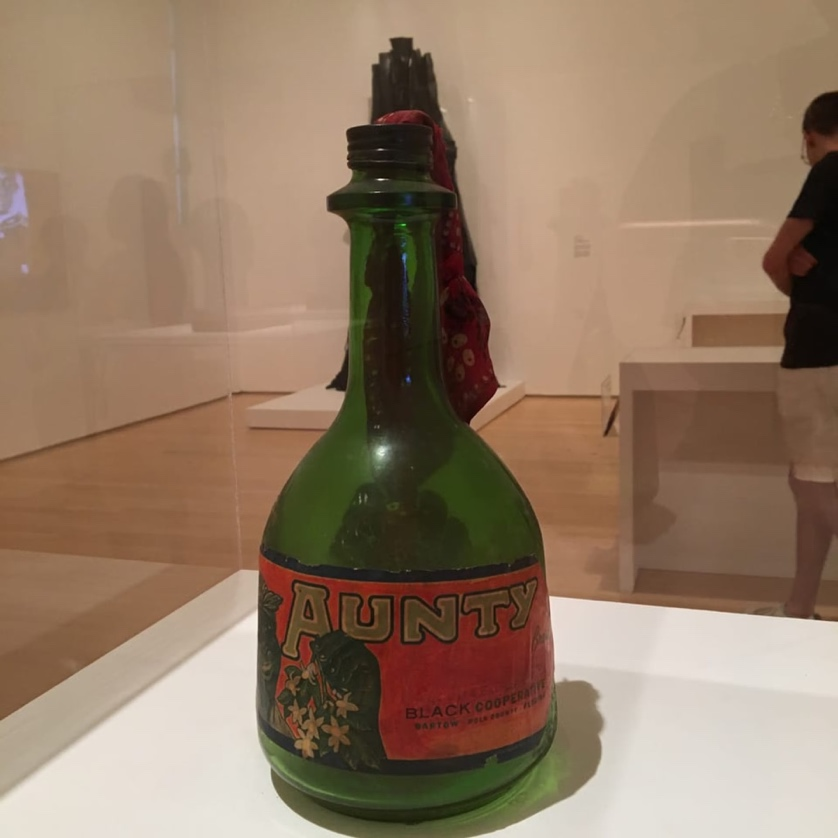
Through the 1970s and 1980s, Saar deepened her practice of what she came to call “liberating” racist imagery. She made pilgrimages to flea markets, estate sales, junk shops, and antique stores across the country, specifically seeking the most egregious examples of racist American kitsch—the figurines, the salt and pepper shakers, the cookie jars, the plantation postcards. She brought them home and went to work.
Her Workers + Warriors: The Return of Aunt Jemima series, which she began in the late 1980s and continued into the 1990s, expanded the single iconic piece into a sustained meditation on Black women’s labor and resistance across American history. The series placed Aunt Jemima in new contexts, gave her new companions, armed her in new ways, positioned her alongside other figures from the visual lexicon of Black degradation – all of them reconfigured, all of them redirected.
This was not nostalgia and it was not irony in the postmodern, distancing sense. Saar held the sharpest possible conviction that these images carried live ammunition, that they still functioned as weapons against Black dignity, and that her job was to disarm them by turning them around. She spoke about this process in interviews with a directness that some found unsettling. She said she wanted to make people angry. She said she believed art had an obligation to disturb. She said the comfortable relationship between the museum and the viewer was something she actively worked to disrupt.
During this same period, she also produced work that engaged with nuclear anxiety, environmental devastation, and the broad sweep of late-Cold-War American social crisis. She understood her position as a Black woman artist in America as embedded in a larger web of violence—the violence of racism, the violence of ecological destruction, the violence of militarism—and her assemblages from this era reflect that expansive political vision.
Faith Ringgold and Betye Saar:
Black Artistic Unity Without Uniformity
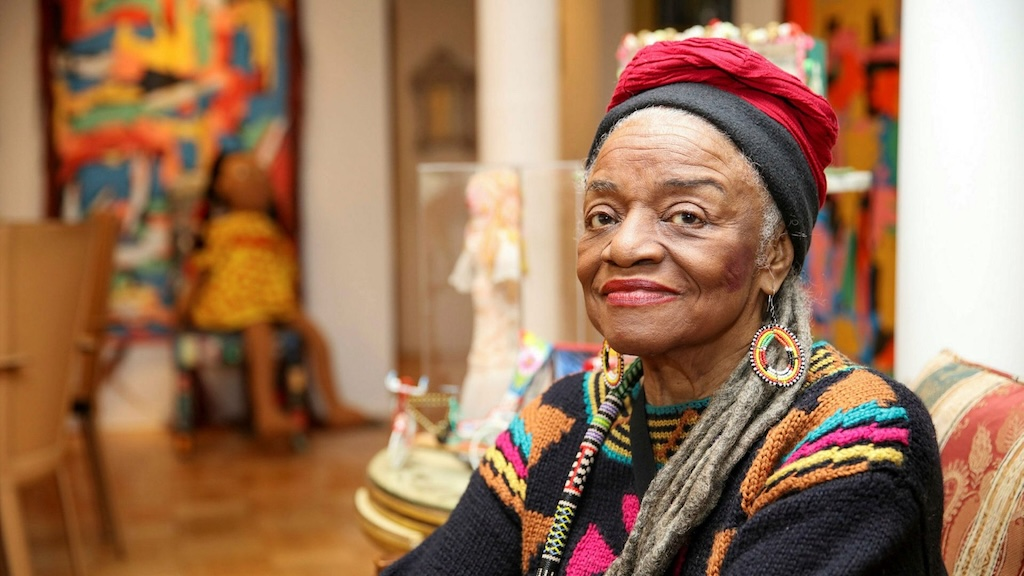
Faith Ringgold (left) and Betye Saar represent two of the most powerful forces in Black feminist art of the twentieth century, and their relationship carried both deep solidarity and genuine creative tension—the kind of productive friction that serious artists with serious convictions generate when they occupy the same political and cultural space.
The solidarity ran deep. Both women came of age as artists during the Civil Rights and Black Power eras and both centered Black women’s experiences as primary subject matter at a time when the mainstream art world considered that choice a liability. Both fought simultaneously against the racism of feminist art institutions and the sexism of Black cultural nationalist movements—a double exclusion that Ringgold articulated loudly and publicly and that Saar navigated through the quiet political force of her objects.
The tension emerged most visibly around the question of racist imagery. In the early 1990s, Ringgold became one of the most prominent voices arguing that artists—including Saar—who recycled and reconfigured racist caricatures risked reinforcing those images regardless of their transformative intent. Ringgold held that the mammy, the sambo, the pickaninny carried such accumulated psychic damage that no artistic recontextualization fully neutralized their harm. Saar pushed back firmly, maintaining that reclamation required direct engagement with the material, that turning away from the image surrendered power to it.
This debate reverberated across the Black arts community and generated serious critical literature. It demonstrated that Black women artists held the political stakes of their work at the highest level—high enough to disagree sharply with their peers over questions of method and consequence.
Both women were right in ways the other’s position could not fully contain. That tension produced better thinking about political art than easy agreement ever would have.
Elizabeth Catlett and Betye Saar: Sistas-In-Struggle
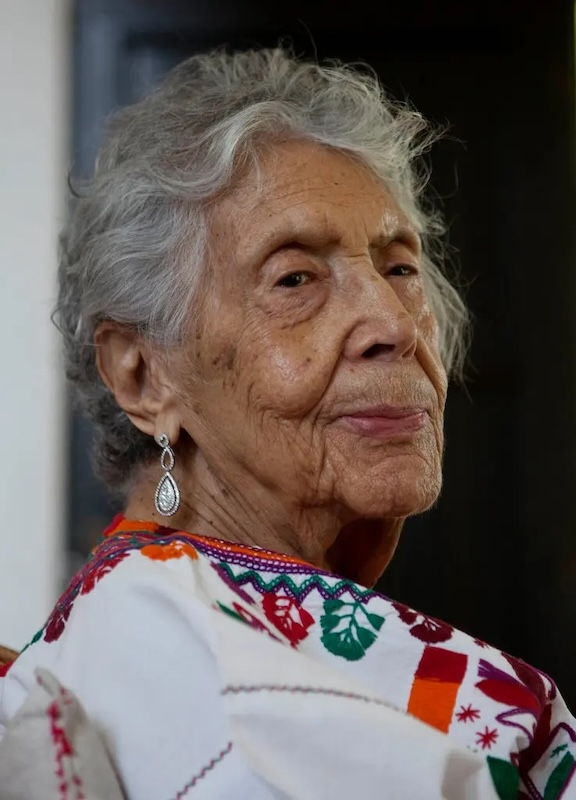
Elizabeth Catlett and Betye Saar occupied parallel positions in the landscape of Black radical art—two women of extraordinary conviction whose careers ran alongside each other for decades, bound by shared political commitments, shared aesthetic concerns, and mutual deep respect.
They belonged to the same ideological current. Both women centered Black womanhood as their primary subject. Both drew from African and African diaspora visual traditions as source material rather than decoration. Both understood their art as inseparable from the political condition of Black people in America and across the diaspora. Catlett, working primarily in sculpture and printmaking from her base in Mexico after the U.S. government’s harassment through the McCarthy era drove her out, and Saar, working in assemblage from Los Angeles, approached that shared terrain through different formal languages but with strikingly convergent intentions.
Their relationship was one of mutual recognition among peers who did not need to occupy the same room to understand each other’s work deeply. Saar spoke of Catlett in interviews with genuine reverence, placing her among the foundational figures whose example demonstrated that a Black woman artist could sustain an uncompromising political vision across a full lifetime without surrendering it to market pressure or institutional demand.
The generational proximity mattered too. Catlett was born in 1915, Saar in 1926—close enough that they shared the experience of building careers during the period when American institutions actively excluded Black women from serious consideration, and close enough that each could witness the other’s persistence as a living proof of what sustained commitment produced.
It must be noted that both Sisters Catlett and Saar had two iconic Black Women holding a weapon. For Catlett it was Harriet Tubman with her ever present rifle (Sista Harriet always had a weapon with her once she became a Conductor). For Saar it was Aunt Jemima holding a rifle. . . flipping the “passive/happy/good negress” script. These imageries put fear into whitefolks—because the Second Amendment was really about policing Blackfolk—free or enslaved and not granting the right of all US citizens to bear arms.
Their legacy as a pair of Black Woman Artists stands as one of the most important chapters in the history of Black women’s radical visual art.
An Artist the Capitalists Cultural Institutions Tried to Slow and Could Not Stop
Saar’s relationship with the mainstream art establishment followed a trajectory familiar to Black women artists of her generation: long periods of relative institutional neglect, followed by recognition that arrived late and sometimes in forms she found inadequate. The major American museums were slow to collect her work with any seriousness. Her place in the canon of American assemblage art— a canon that celebrated Joseph Cornell, Robert Rauschenberg, and Edward Kienholz with enormous institutional enthusiasm—took decades to properly acknowledge.
She responded to this dynamic with characteristic directness: she kept working. She travelled internationally, exhibiting in Europe, Africa, and Asia. She built relationships with Black institutions, community galleries, and university collections that the mainstream market undervalued. She mentored younger Black artists with a generosity that many of them, now established figures themselves, have described as transformative.
Recognition accumulated regardless. She received a National Endowment for the Arts fellowship. The Los Angeles County Museum of Art mounted significant exhibitions. The Museum of Modern Art in New York eventually collected her work. The Smithsonian American Art Museum, the Art Institute of Chicago, the de Young Museum in San Francisco: the collection credits grew.
In 2019, the Los Angeles County Museum of Art presented Betye Saar: The Legends of Black Girl’s Window, a major retrospective that brought her earliest work into conversation with her most recent productions and made visible the astonishing coherence of a vision that had never stopped evolving.
She received honorary doctorates from institutions across the country, the prestigious MacArthur Fellowship, grants from the Guggenheim Foundation, and the National Medal of Arts, awarded to her in 2014 by President Barack Obama. She accepted these honors with grace and without the suggestion that they had come in time.
The Family Legacy: A Dynasty of Black Visual Art
Betye Saar raised three daughters—Lezley Saar, Alison Saar, and Tracye Saar-Cavanaugh—two of whom became major visual artists in their own right. Alison Saar in particular has built a career of extraordinary power and political depth, working in sculpture and installation to address the African American body, history, and spiritual tradition with an intensity that clearly carries her mother’s influence while speaking entirely in its own voice. Lezley Saar’s work in painting and assemblage extends the family’s engagement with the interior lives and cultural histories of Black women.
This multigenerational dimension of Betye Saar’s legacy places her in a category few American artists occupy. She did not simply produce a body of work, she produced a lineage, a visual dynasty whose influence will compound across time. When scholars examine the Saar family’s collective contribution to American art, they encounter one of the most sustained, politically conscious, aesthetically rigorous explorations of Black womanhood that this country’s culture has ever generated.
What She Built and What It Means
Betye Saar worked for over seven decades and she never softened her edge. At an age when most artists rest inside their legacies, she continued to make new work, continued to push new materials through new configurations, continued to find in the discarded and the overlooked the raw material of transformation. Collectors and critics who visited her studio in her late nineties described a workspace dense with objects in process—things waiting to be understood, waiting to be placed in relationship to one another, waiting to become something that had not existed before.
The nature of her radicalism deserves a final accounting. Betye Saar did not make protest art in the simple sense—the art that holds up a sign, that illustrates a grievance in the way a newspaper illustration might. She made work that restructured the viewer’s relationship to history at the level of the object, the level of the material, the level of the hand. She understood that ideology lives inside everyday objects—inside the mammy figurine on the kitchen shelf, inside the pickaninny postcard in the shoebox, inside the Sambo figure on the restaurant sign—and that the way to fight ideology is to enter its own materials and rewire them.
This was—and remains—a profound contribution to the theory and practice of political art.
Many artists address racism.
Few have gone so directly to the mechanisms by which racism reproduces itself culturally and materially, seized those mechanisms, and reversed their polarity.
Sista Saar did this with her hands, in shadow boxes, over the course of a lifetime, and the results hang in the permanent collections of the greatest museums in the world and in the memories of every Black woman artist who saw The Liberation of Aunt Jemima and felt the permission it carried.
Betye Saar is survived by her daughters Lezley Saar, Alison Saar, and Tracye Saar-Cavanaugh; her grandchildren; and an American art world that will spend generations fully reckoning with what she created and built.
